SparkPilot deployment
Control plane, customer account, persistent state and external services.
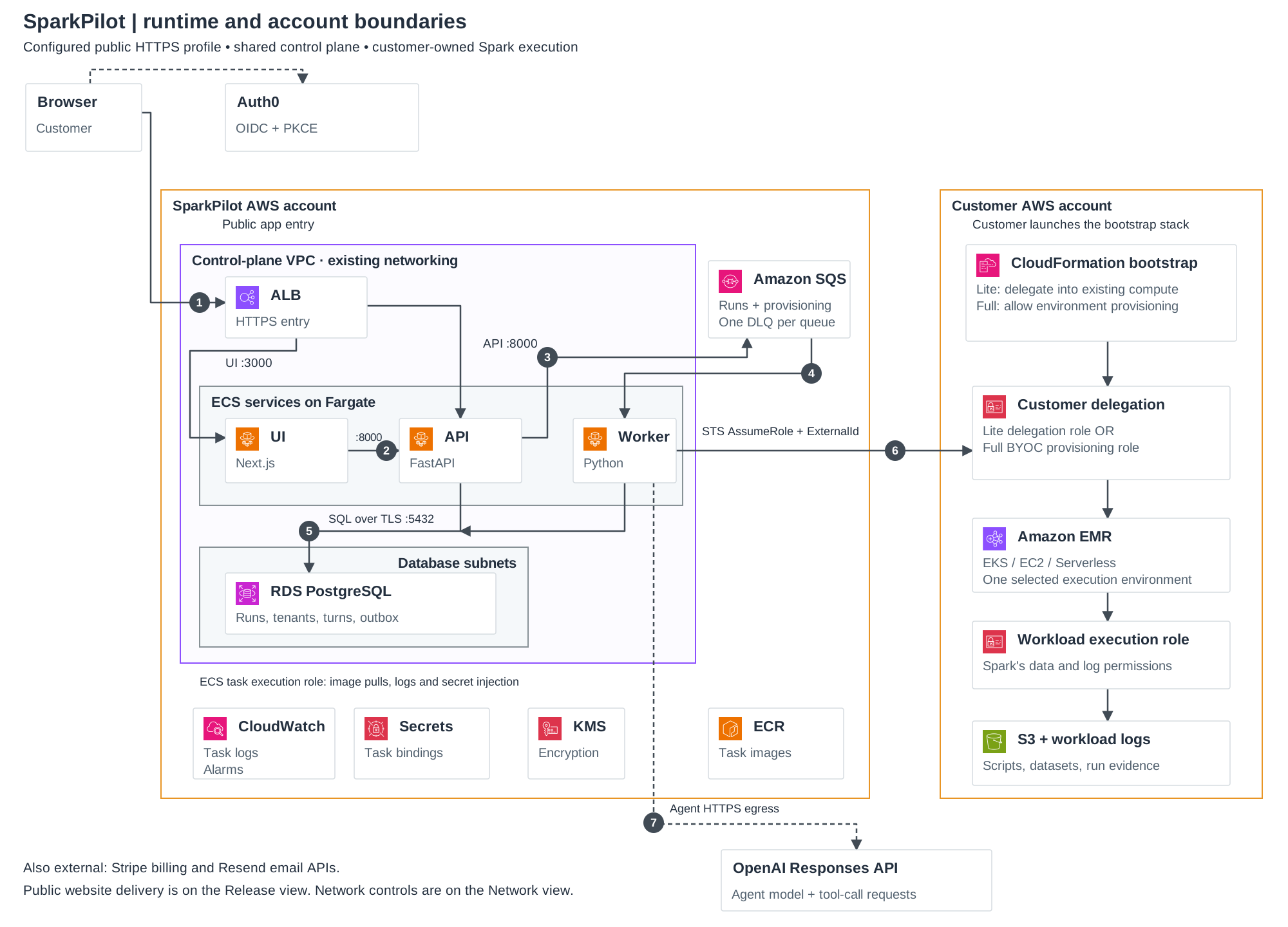
Runtime flow
- The browser enters through HTTPS at the Application Load Balancer. Auth0 sign-in establishes the application session.
- Next.js proxies authenticated requests to the private FastAPI address. The API checks identity and resource permissions.
- For environment setup and run submission, the API commits the work and outbox record, then publishes its identifier to the appropriate SQS queue.
- The worker receives work, loads saved state and advances provisioning or workload submission. Each queue has its own dead-letter queue.
- API and worker processes share durable PostgreSQL records. The worker's reconciler saves the AWS job's observed state.
- SparkPilot assumes the customer's delegation or provisioning role. EMR workloads use their separate execution identity for scripts, data and logs.
- The agent thread calls the external model API over HTTPS. Python controls tool execution and action approval.
Deployment assumptions and verification gaps
- Existing control-plane VPC, subnet IDs, routes, certificate and deployment roles are supplied inputs. Their live ownership and settings require an AWS inventory.
- Endpoint creation, audit settings, service counts and recovery settings depend on configuration. Terraform check blocks emit warnings; they do not prevent an apply.
- Customer access policies differ by provisioning profile. The full-BYOC execution policy contains broad S3, logging and image-read permissions; a universal least-privilege claim would be inaccurate.
- WAF, an AWS Config recorder, AWS Budgets and a separate AWS Backup plan are not defined in the inspected modules. They may be managed elsewhere.
- Alarm delivery, backup restoration, failure recovery, current availability-zone placement and customer data isolation need runtime evidence. These maps do not establish AWS Well-Architected compliance.
Configuration, source evidence and AWS references
Source snapshot 0851cee, inspected October 16, 2026. The maps show the public HTTPS profile and agent-enabled worker configuration. They are source-reviewed diagrams; active DNS/CDN routing, replica counts, availability-zone placement and egress settings require a current deployment inventory.
infra/terraform/control-plane/main.tf: VPC inputs and API DNS 197–202; worker command 423–425; queues 669–706; network controls 749–982; load balancer 984–1125; task roles and services 1138–1677.infra/cloudformation/customer-bootstrap-byoc-lite.yamlandcustomer-bootstrap-full-byoc.yaml: customer role creation and trust.infra/terraform/full-byoc/: customer environment infrastructure.infra/terraform/control-plane/operations.tf,security_monitoring.tf,audit_logging.tfandterraform_state_backend.tf: alarms, security findings, audit storage and customer provisioning state.infra/cloudformation/customer-cost-reconciliation.yaml: the separate billing-data role.src/sparkpilot/services/finops.py: allocation and reconciliation limits..github/workflows/ci-cd.yml: application release.scripts/terraform/deploy_control_plane.sh: deployment sequencing..github/workflows/public-site.yml: static-site publication.infra/terraform/control-plane/cfn_templates.tf: public, read-only bootstrap-template publication.infra/terraform/full-byoc/network/,eks/,emr/andk8s-runtime/: customer networking, cluster registration and workload identity.src/sparkpilot/services/control_tower.py: external model requests and local tool dispatch.ui/app/auth/,ui/app/api/auth/session/and API identity code: application sign-in.
Reviewed against the AWS Well-Architected Framework and official reference diagrams, accessed October 16, 2026. Official AWS icons from the July 31, 2026 package. Visual references: AWS Architecture Icons, ECS inbound networking, cross-account SaaS access and numbered reference-diagram example.